


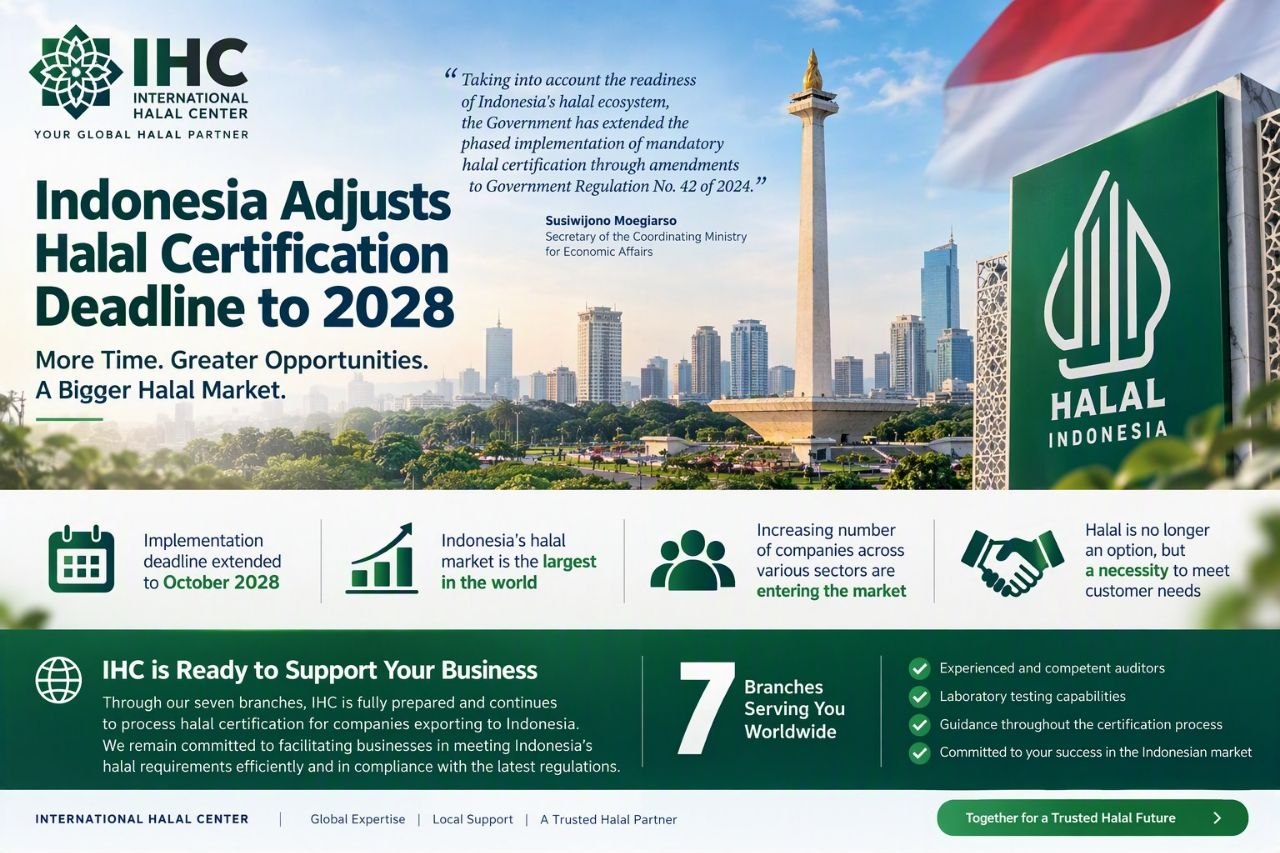
Indonesia Adjusts Mandatory Halal Certification Timeline to 2028: IHC Remains Ready to Support Exporters
Date: 17 Oct 2026 (2 weeks ago)
International Halal Center (IHC)
The Government of Indonesia has announced an adjustment to the phased implementation timeline for mandatory halal certification, extending the deadline for several categories of products and services from October 2026 to October 2028.
According to the official announcement of the Coordinating Ministry for Economic Affairs of Indonesia, the adjustment is being introduced to allow additional time for strengthening the halal ecosystem and improving the readiness of businesses and other stakeholders.
Revised timeline
Under the announced amendments to Articles 160 and 161 of Government Regulation (PP) No. 42 of 2024:
Products from outside Indonesia, including food, beverages, slaughter products and slaughtering services. Mandatory halal certification begins on this date, taking into account the completion of mutual recognition arrangements for halal certificates.
Traditional medicines, quasi-drugs, health supplements, cosmetics, chemical products, genetically engineered products and certain consumer goods. The transition period is adjusted to this date.
Local Indonesia market: Food, beverages and slaughter products, excluding slaughtering services. Mandatory certification is scheduled to begin on this date.
Micro and small enterprises. The phased period covering food, beverages, slaughter products and slaughtering services is extended until this date.
Regulatory follow-up
Implementing regulations related to PP No. 42/2024 will be adjusted accordingly. BPJPH Regulation No. 4 of 2026, concerning conformity assurance for foreign halal products entering Indonesia, will be revoked.
Additional time does not mean halal becomes less important
The extension should not be interpreted as reducing the significance of halal certification for companies seeking access to the Indonesian market.
On the contrary, IHC considers the additional transition period an important opportunity for manufacturers, exporters and international businesses to prepare their products, supply chains, documentation and halal compliance systems in advance.
For companies seeking to establish or strengthen their position in Indonesia, halal certification should increasingly be regarded not merely as a future regulatory obligation, but as a strategic market requirement.
With a very large Muslim consumer base and an expanding halal ecosystem, Indonesia represents one of the most significant international markets for halal products. As more companies across food, cosmetics, pharmaceuticals, supplements, chemicals and other sectors enter the Indonesian market, meeting halal requirements becomes increasingly important for customer expectations and market confidence.
IHC continues to support companies exporting to Indonesia
International Halal Center (IHC) remains fully operational and committed to supporting companies seeking halal certification for products intended for the Indonesian market.
Through our seven branches, IHC continues to provide halal certification services to international manufacturers and exporters, and to support businesses in preparing for the evolving Indonesian halal regulatory framework.
Companies should use the extended period strategically rather than postpone their halal preparations. Early preparation can help address:
- Product composition and raw materials
- Production processes
- Supply-chain requirements
- Certification documentation
Our Message to Exporters
The deadline has changed. The importance of halal has not.
For companies targeting Indonesia, halal is increasingly more than a certification requirement. It is an important element of market access, consumer confidence and long-term positioning. IHC and its seven branches are ready to support companies throughout their halal certification journey.
Begin halal certificationCertification process
Keywords
Halal certificationIndonesiaOctober 2028BPJPHPP 42/2024ExportersMutual recognition
Source (in Indonesian): Coordinating Ministry for Economic Affairs